
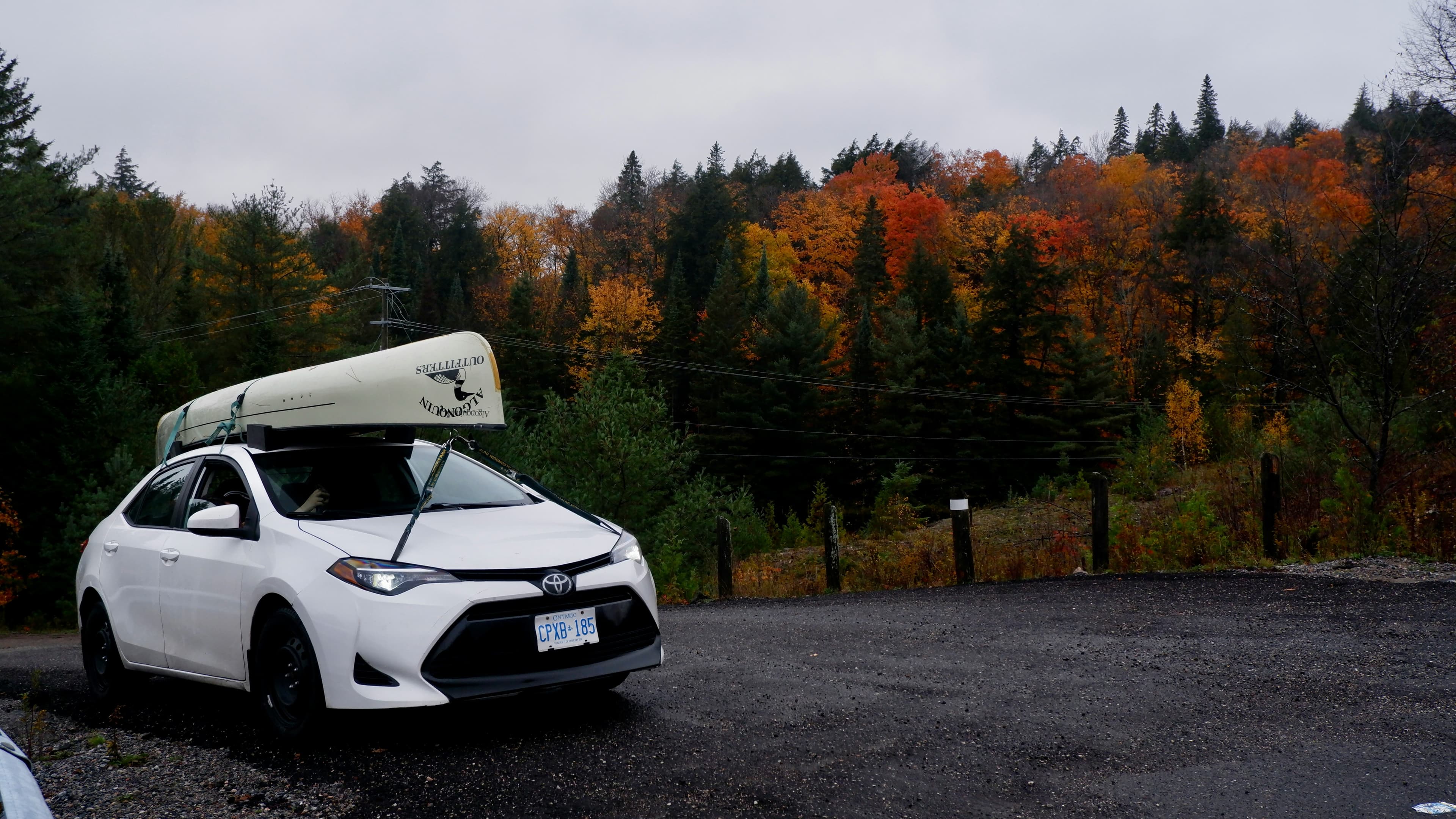
A backcountry trip in Algonquin or Killarney comes down to four things: shelter, a canoe, a way to store food from bears, and a way to treat water. Rent the canoe, the barrel, and the big single trip items, and own the personal ones. A full outfitting package from a park outfitter runs about $230 per person for a weekend plus HST.
All prices below are in Canadian dollars and were checked in July 2026, so treat them as the shape of the cost rather than a quote. This is the companion to where to rent camping gear in Toronto, which covers where to get the gear. This one is about what you actually need to carry and which pieces are worth renting instead of buying.
The two parks reward the trouble. Algonquin is the classic interior canoe route network, all portages and lake chains. Killarney is the one with the white quartzite ridges of the La Cloche mountains rising over sapphire lakes, described well in this guide to Killarney canoe routes. Both are backcountry, which means you carry everything in and pack everything out.
What do you actually need for a canoe trip?
Every backcountry canoe trip reduces to five systems: shelter, a warm sleep setup, a canoe with paddles and life jackets, bear proof food storage, and water treatment. Add a stove, a headlamp, and a small first aid kit and you have the whole list. Everything else is comfort. Here is the full checklist, sorted by whether the item is worth renting or owning.
| Item | Rent or own | Why | Rough cost |
|---|---|---|---|
| Canoe, paddles, life jackets | Rent | Hardest thing to move from the city, and a park outfitter is already at the water | About $51 a day for a Kevlar canoe, paddles and PFDs included |
| Barrel pack for food | Rent | Bear proof storage you need once, not something to own | About $10 a day |
| Four person tent | Rent | Big, used a few times a year, awkward to store and dry at home | $15 to $25 a day from a neighbour, about $12 a day at a park outfitter |
| Sleeping bag | Own once you camp often | Warmth is personal, and a borrowed bag rarely fits your temperature | About $8.50 a day to rent, roughly $150 and up to buy |
| Sleeping pad | Own | Cheap, small, and comfort is personal | About $2 to $8 a day to rent |
| Camp stove and fuel | Rent | Used occasionally, and fuel cannot travel on a plane anyway | $3.50 to $5 a day, fuel bought separately |
| Water filter or tablets | Own the habit, rent the hardware first | You will treat water on every trip you ever take | About $6 a day to rent a filter, or $12 for 50 tablets |
| Headlamp | Own | Cheap, personal, and you want a reliable one | Roughly $30 to $60 to buy |
| Boots and clothing | Own | Fitted to your body, and rentals rarely exist | Buy over time |
| Map, compass, first aid kit | Own | Safety gear you keep and reuse | Buy once |
Prices for canoes, barrels, tents, bags, and filters come from Killarney Kanoes' 2026 rate card, which publishes clear per day numbers and adds a $10 delivery fee and 13 percent HST.
What should you rent and what should you own?
The rule is frequency, not price. Rent the big shared items and anything you use once or twice a year, because a canoe rents for about $51 a day and a barrel pack for about $10 a day, and buying either to sit in a condo makes no sense. Own the personal gear fitted to your body, since a borrowed sleeping bag or ill fitting boot can ruin a trip.
That split maps cleanly onto a canoe trip. The canoe, the barrel, the tent, and the stove are shared, bulky, and used a handful of times a year, which puts them firmly in the rent column. Boots, a headlamp, and eventually a sleeping bag are personal and cheap enough to own once you know you will keep camping. The general version of this reasoning is the five uses a year rule: if you will use something fewer than five times a year, renting usually wins.
For a remote park trip, circld fills one specific gap. It is a new peer to peer rental app for Toronto and the GTA, on iOS and Android, and the natural thing to rent through it is the tent, stove, and sleeping gear you pick up in the city before you drive north. Listing is free and there is no commission, so you agree on dates and price in chat and pay the owner directly. The canoe and the barrel are a different story: those are better rented at the park gate, where the outfitter already has the boats, the food packs, and the route knowledge.
Being new cuts both ways, and it is fair to say so. Inventory is growing but still limited, so the four person tent you want may not be listed in your postal code yet, and there is no payment processing, insurance, or held deposit. Every listing is reviewed before it goes live, owners can ask for a refundable deposit in chat, and the pickup and safety notes cover how to handle the handoff. If your own tent and stove sit idle most weekends, you are the supply side of this, and what your idle gear could earn does that math.
When do you reserve permits and book the canoe?
Reserve the backcountry site five months ahead. Ontario Parks opens reservations at 7 am eastern, five months before your arrival date, so a July 1 start opens on February 1, and popular routes on summer Saturdays can be claimed within minutes of the window opening. Book the canoe and barrel as soon as your dates are firm, especially for July and August.
The park side is a reservation and a permit. The Friends of Algonquin Park confirm the five month window, and Ontario Parks charges a backcountry camping fee per person per night on top of the reservation, handled through the same Ontario Parks reservation system. Killarney works the same way, with interior sites booked through Ontario Parks and the canoe rented separately.
The gear side runs on the same calendar as the campsites. Killarney Kanoes rents from the Bell Lake access point inside the park, and Killarney Outfitters runs all inclusive packages with ultra light Kevlar canoes just outside it. Barrels and boats are finite, so a canoe you assume will be there on a long weekend may already be out. Message a peer to peer host in the city a couple of weeks ahead for the tent and stove, and reserve the outfitter gear the moment the dates are set. Canada Day, the August civic holiday, and Labour Day empty every shelf at once.
How do you store food so bears leave you alone?
Most Ontario canoe trippers carry a hard plastic barrel and hang the food pack at least four metres, about 13 feet, off the ground and two metres, about 7 feet, from the tree trunk. Keep all food, soap, and toothpaste out of the tent, and cook and wash dishes well away from where you sleep. A clean camp is the single biggest thing keeping a bear disinterested.
The specifics come from the Friends of Algonquin black bear safety rules. Put all food and anything scented into a pack or barrel and hang it away from your sleeping, cooking, and canoe areas. Burn food scraps thoroughly in a hot fire, never plastics or foil, and wash dishes away from the water you drink from. Ontario provincial park backcountry does not mandate hard canisters the way some western parks do, so the barrel plus a proper hang is the norm here. A barrel is waterproof, floats, doubles as a seat, and holds far more than a canister, which is why outfitters rent them by the day.
If you do meet a bear, your response depends on the bear. A defensive bear that huffs, pops its teeth, or swats wants space: stop, face it, and back away slowly while watching it. The extremely rare predatory bear is the opposite case, where you make yourself big, yell, and throw rocks rather than run or play dead. Both are unlikely if your food is hung and your camp is clean.
How do you treat water in the backcountry?
Treat every litre you drink from a lake or stream. A hollow fibre filter removes the protozoa that cause giardia, sometimes called beaver fever, along with bacteria, and it also clears the sediment you pick up dipping a bottle. Purification tablets are lighter and cheaper, about $12 for a pack of 50, but they take time to work, leave a chemical taste, and do nothing about floating gunk.
For most Ontario canoe trips a filter is the practical choice, as the REI water treatment guide lays out. A gravity filter is the easiest for a group because you hang it and walk away, and a squeeze filter is fine for one or two people. Tablets earn a place as a light backup in case a filter clogs or freezes. Whichever you carry, treat water for drinking, brushing teeth, and rinsing anything that goes in your mouth.
The last habit worth building is Leave No Trace. The seven Leave No Trace principles from Leave No Trace Canada come down to a simple discipline in a park like Algonquin or Killarney: pack out everything you carried in, including food scraps and micro trash, bury human waste in a hole more than 60 metres from water and campsites, and leave the site cleaner than you found it. It is also the best bear safety habit there is.
What does a weekend actually cost?
A two day weekend works out three ways. A full outfitting package from a park outfitter is about $230 per person plus HST, with the canoe, gear, and food included. Renting only the canoe, barrel, and filter while bringing your own tent and sleep gear costs roughly $60 to $90 per person plus HST. Owning everything is about $800 up front, then close to nothing per trip after that.
| Approach | What you pay for | Rough weekend cost per person |
|---|---|---|
| Full outfitting package | Canoe, all gear, and food from a park outfitter | About $230 plus HST |
| Rent the big items only | Canoe and barrel from an outfitter, your own tent and sleep gear | About $60 to $90 plus HST |
| Own everything | Tent, bags, pads, stove, filter bought up front, canoe still rented | Roughly $800 up front, then the canoe rental |
The middle row is where most repeat trippers land. A complete Algonquin Outfitters package removes every decision and is worth it on a first trip, and the same outfitter charges $285 a day for a guide shared by the group and $25 per person for a three hour skills session covering camp setup, food storage, and portaging. Once you own a tent and a bag, you rent the boat and the barrel and skip the rest, which is why the second row is so much cheaper. Owning everything only pays off past the frequency the five uses rule describes.
First trip? Rent almost all of it
If this is your first canoe trip, rent nearly everything. A decent four person tent costs about $400 to buy, and until you have slept in one you cannot know whether you will do this twice or twenty times, or whether you want a light two person tent instead. Renting your first kit is not a compromise, it is the correct order of operations.
Buy the personal items first: boots, a headlamp, a warm layer, a sleeping bag if borrowed ones bother you. Rent the shared items, the tent, the stove, the canoe, and the barrel, until frequency earns them a spot in your closet. Most first timers over pack, and a rented kit lets you learn that the camp kitchen mattered and the extra chair did not before you have paid retail for either.
When the dates are set, it costs nothing to check what people near you are renting out or to browse the outdoor and camping section for the tent and stove you carry from the city. Reserve the canoe and barrel from the park outfitter, sort the campsite the moment your five month window opens, and the trip comes together in the right order. The gear is the easy part once you know which pieces to rent and which to carry from home.